 |
| Source: Google |
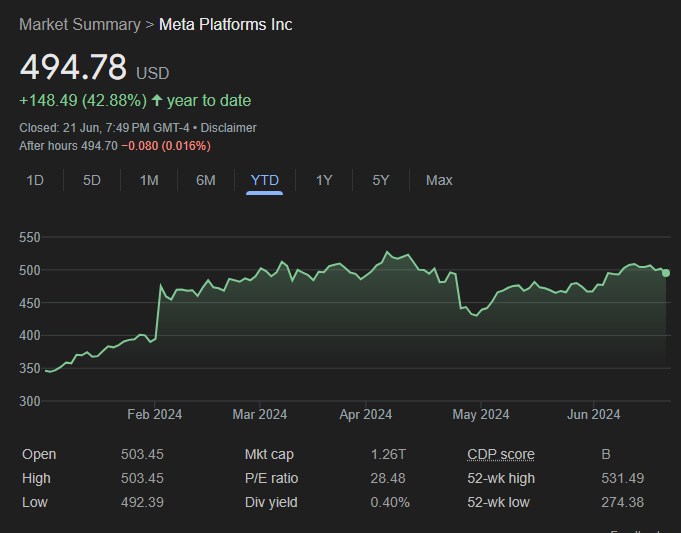
Meta Platforms' stock has been on a tear recently. Despite a sharp dip after their April earnings report - where strong results were overshadowed by concerns over growing capital expenditures - the stock has since rebounded, flirting with all-time highs. This demonstrates the incredible momentum behind the stock.
 |
| Source: Google |
Meta shareholders endured a brutal 2022, to say the least. I myself took advantage of the steep declines to accumulate shares, averaging in at $190. I continued to hold through the volatility, only trimming 10% of my position earlier this year, and another 10% recently. However, this doesn't reflect a bearish view on Meta. Today, let's dive into an analysis of the company's prospects.
Meta Q1 2024 Earnings Highlights
Meta operates two primary business segments:
- Family of Apps (FoA): Encompassing Facebook, Instagram, Messenger, and WhatApp, this segment leverages Meta's well-known applications and derives its primary revenue from digital advertising.
- Reality Labs (RL): This segment is dedicated to Meta's metaverse ambitions, encompassing VR hardware and all supporting elements of the metaverse ecosystem.
Family of Apps Performance
The family of Apps boasted 3.24 billion daily active users (DAUs) in Q1 2024, a 7% year-over-year increase. This staggering figure represents the number of individuals worldwide who engage with at least one Meta app daily. Not only is the sheer scale impressive, but the continued 7% growth year-over-year is remarkable, given the already widespread adoption of these platforms. It seems Meta continues to find avenues for growth even in seemingly saturated markets.
 |
Source: appeconomyinsights.com
|
Meta's Q1 2024 revenue reached a staggering $36.5 billion, a 27% year-over-year surge. Of this, digital advertising within the Family of Apps accounted for $36.5 billion, effectively mirroring the overall growth rate. Additionally, payment infrastructure generated $400 million, an 85% increase year-over-year, while Reality Labs saw a 30% uptick to $400 million, driven by the Quest 3 launch. However, these latter two segments remain a minor fraction of Meta's total revenue.
The company's gross profit margin hit an impressive 82%, with operating margin reaching 38%. These figures significantly surpass the prior year, emphasizing the focus on efficiency. However, Reality Labs still posted a $3.8 billion operating loss. This ultimately led to a net income margin of 34%, resulting in a $12.4 billion profit for Meta shareholders in Q1. This translates to an EPS of $4.71, handily beating the consensus estimate of $4.32.
Despite these stellar results, Meta's stock price plummeted by roughly 11% post-earnings. This was largely due to CEO Mark Zuckerberg's comments about prioritizing AI investments, which could lead to short-term profitability challenges. He appealed to investors for patience, but the market reacted negatively, resulting in the sharp share price decline.
Meta AI: A Necessity for Success
Meta already possesses its own AI model, the open-source Llama. With Llama 3 now available, it offers versions trained on 8 billion and 70 billion parameters, with a 400 billion parameter model in the works. While performance may lag behind closed models like GPT-4 or Gemini, the 8 billion parameter version is remarkably lightweight, even capable of running on a laptop. Additionally, it boasts a 20x cost advantage over GPT-4 when running on cloud platform via API. As an open-source model, Llama offers unparalleled flexibility for user customization.
The battle between closed models and open-source Llama, with its potential to foster a vast ecosystem, remains to be seen. However, from a shareholder perspective, Meta AI is not just beneficial but essential for the company's future endeavors. Zuckerberg's decision to invest in AI was not only necessary but crucial to avoid the risk of Meta being overtaken by emerging technologies.
Let's explore how Meta's AI technology can synergize with its existing products:
- Maximizing User Engagement with AI-Personalized Content: Over 50% of Instagram click content is already AI-driven. AI can analyze user interests and behavior patterns to recommend tailored content, increasing engagement and time spent on the platform. Meta can also empower creators with AI tools for easier content creation, further boosting interaction.
- Optimizing Ad Effectiveness with AI-Powered Solutions: AI can enhance ad targeting accuracy by analyzing user data, leading to improved ad performance and increased revenue for Meta. AI can also automate ad creation for smaller businesses, reducing costs and improving overall ad efficiency.
- Revolutionizing Business Messaging with AI: Meta, already dominating the messaging app market with WhatsApp, can integrate LLMs into business messaging for enhanced customer satisfaction and streamlined operations. 24/7 AI-powered customer support can improve user experience while reducing costs for businesses.
- Building AI Agents and an Agent-Based Metaverse Ecosystem: AI agents can execute tasks based on user intent, from online research to product searches. These agents can be integrated into Meta's mobile apps or even future hardware like AR glasses. This technology can also synergize with Meta's metaverse ambitions, enhancing VR experiences and potentially revolutionizing the platform.
Meta's massive user base, exceeding 3 billion active users, provides a significant advantage in AI development. This wealth of data can be leveraged to refine and expand AI capabilities, further solidifying Meta's position in the tech landscape.
In conclusion, Meta's success in AI is paramount for its long-term growth and profitability. By harnessing AI technology, Meta can increase revenue, reduce costs, and deliver greater value to its shareholders. Failure to do so could jeopardize its competitive edge and leave it vulnerable to disruption from other tech giants or AI-powered startups.
Valuation and Investment Thesis
Following the last earnings report, a simple numerical update to my valuation model suggested a fair value of $435 for Meta, leading to a neutral stance on the stock. However, further research indicates potential for significant revenue growth in business messaging alongside AI advancements, in addition to digital advertising. The widespread adoption of the open-source Llama 3 among developers also hints at future revenue streams.
Based on the following assumptions, I've recalculated Meta's fair value:
Assumption 1: Cost of Capital, Effective Tax Rate, and Perpetual Growth Rate
While debt costs are clear, calculating the cost of equity using the CAPM model often proves inaccurate. Until a more refined model is available, I've adopted Professor Damodarans' Feb 2024 calculation for Meta's cost of capital, starting at 8.83% and gradually decreasing to 8.58% over ten years.
Meta's current effective tax rate is 17.6%, but I've conservatively assumed it will reach the US corporate tax rate of 25%.
Meta's perpetual growth rate is debatable, but as a global multinational with over 3 billion active users, I believe a 4% perpetual growth rate is reasonable, assuming user base maintenance.
Assumption 2: Revenue Growth Rate and EBIT Margin
I've projected Meta's 10-year average annual revenue growth at 11.2%, combining 8% advertising growth with additional AI-driven revenue.
The EBIT margin forecast is 40%, as the current 38% margin is already high and unlikely to improve significantly.
Based on these assumptions, Meta's fair value ranges from $390 to $615, depending on perpetual growth rate and cost of capital projections. My estimated fair value is around $469.
Of course, this valuation could change drastically depending on various factors. Lower interest rates or successful metaverse ventures could drive the fair value higher, while rising rates or AI setbacks could lower it.
In conclusion, my investment stance on Meta remains neutral, and I intend to hold my current position. Remember, stock valuation are highly sensitive to underlying assumptions, so please use this analysis as a reference only for your investment decisions.
Thank you.


Comments
Post a Comment